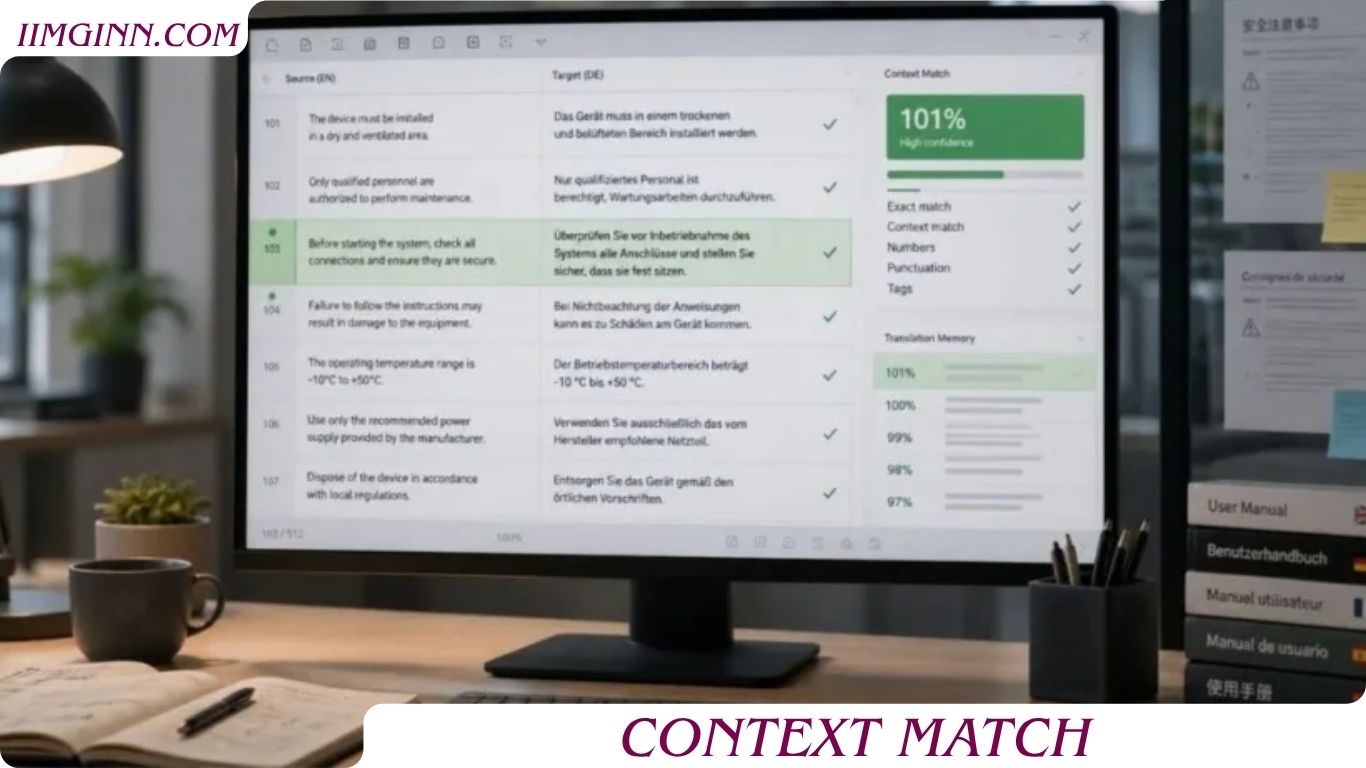
Context Match: Meaning, Definition, and How It Works
A context match is a term mainly used in translation technology, especially in translation memory and computer-assisted translation (CAT) tools. It describes a high-confidence match where a new source segment matches a previously translated segment and the relevant context around it also matches.
In simple words, a normal exact match tells a translator that the same sentence has been translated before. A context match provides another level of confidence because the system also confirms that the sentence appears in the same or a matching setting.
This can be very useful for professional translators, localization teams, software companies, technical writers, and businesses that regularly translate updated content. It can reduce repeated work, improve consistency, and make large translation projects easier to manage.
Understanding context match is also important for anyone learning how modern translation workflows operate. Although a high match can save time, it should not automatically be treated as proof that an old translation is still correct. The quality of the stored translation, the current project, terminology, and human review all remain important.
What Is Context Match?
Context match is a high-confidence translation memory match in which the current source segment matches a previously stored segment and additional contextual information also matches.
A translation memory stores previously translated source and target-language segments. When a translator works on a new document, a CAT tool searches that memory for content that may have already been translated.
If the same source sentence is found, the tool may identify it as an exact or 100% match. If the surrounding context or other relevant information also agrees, the system may identify it as a context match.
For example, imagine that a software manual previously contained these three sentences:
“Open the application.”
“Enter your account details.”
“Select Continue.”
If the same three segments appear together in a new version, the middle sentence is not only identical to a previous translation-memory entry. Its surrounding context is also the same.
That additional information gives the translator greater confidence that the existing translation can be reused.
The exact definition can vary between CAT tools. Some systems use the previous and next segments, while others can use identifiers, document structure, or other metadata as context.

How Does Context Match Work?
Context matching works by comparing a new segment with information already stored in a translation memory.
The basic process is straightforward.
First, the CAT tool divides the source document into translation units or segments. These are often sentences, phrases, headings, or other content units.
The tool then searches the translation memory for matching source content.
If an identical source segment is found, the system can classify it as an exact match.
After that, the tool may examine additional information surrounding the segment. Depending on the software, this can include the previous segment, next segment, segment ID, document structure, or other contextual information.
If the required contextual information also matches, the system can classify the result as a context match.
This process gives the translator more information than a simple word-for-word comparison.
For example, the phrase “Open the account” could appear in several places. The words are exactly the same, but the intended meaning could depend on the surrounding instructions or the location within an application.
Context matching helps the system determine whether the current use resembles the earlier use.
What Is the Difference Between Context Match and Exact Match?
The main difference is the amount of information being compared.
Also Read: ABS Testauslösung: Complete Guide to Testing an Avalanche Airbag
An exact match generally means that the current source segment is identical to a segment stored in the translation memory.
A context match goes beyond the source segment itself. It also confirms relevant contextual information.
For example:
| Match Type | General Meaning |
| No Match | No useful previous translation is available |
| Fuzzy Match | The new segment is similar to an existing segment |
| Exact Match | The source segment is identical to a stored segment |
| Context Match | The source segment and relevant context match |
A 100% exact match can therefore be considered a strong result, but a context match may provide even more confidence about reuse.
This difference becomes particularly important when a short sentence can be used in several parts of a document or application.
A sentence such as “Save changes” may appear in different screens. The words are identical, but the surrounding content or interface location can differ.
A context match can provide additional evidence that the existing translation belongs to the same use case.
However, the terminology used by CAT software is not completely standardized. Different platforms can define and label these match types differently.
Why Is Context Important in Translation?
Context is important because words and sentences do not always have one fixed meaning.
A translator needs to understand how language is being used, not just which words appear on the screen.
This is especially important with short phrases.
Consider words such as:
- Open
- Close
- Back
- Continue
- Save
- Account
- Order
- Home
- Settings
These terms can have different grammatical or functional roles depending on where they appear.
Context can also affect:
- tone
- grammar
- formality
- gender
- number
- terminology
- sentence structure
- technical meaning
- intended audience
For example, a phrase used as a button label may need a different translation style from the same phrase used inside a complete sentence.
This is why context match can be valuable. It gives the translator additional evidence that the previous translation was used in the same type of situation.
What Is Translation Memory and How Does It Relate to Context Match?
Translation memory, often shortened to TM, is a database of previously translated content.
It normally stores a source segment together with its target-language translation.
For example, a translation memory could contain:
| Source Segment | Stored Translation |
| Welcome to your account. | Approved target-language translation |
| Enter your password. | Approved target-language translation |
| Select Continue. | Approved target-language translation |
When similar content appears again, the CAT tool searches this database.
Instead of asking the translator to translate the sentence from the beginning, the system can present the previous translation as a suggestion.
Context match is therefore closely connected to translation memory.
The translation memory provides the stored information, while the context-matching system evaluates whether the current segment and its surrounding information correspond to an existing entry.
This can make previously translated content easier and safer to reuse.
A well-maintained translation memory is especially valuable for companies that repeatedly update the same documents, websites, applications, or product information.
What Does a 101% Match Mean?
Some CAT tools use a percentage such as 101% to represent a context match.
The number should not be understood literally.
A 101% match does not mean that a translation is “more than 100% correct.” Instead, the number indicates that the system has found an exact match with additional contextual confirmation.
For example, a basic exact match might be shown as 100%.
A context match might be displayed as 101% because the software considers it a stronger match.
Not every CAT tool uses the same percentage system. Some may use terms such as “context match” or “CM” instead.
Therefore, translators should check the terminology and matching rules used by their particular software.
The important concept is not the number itself. The important concept is that additional context has been used to increase confidence in the match.
Also Read: Supermaked: Complete Guide to Modern Grocery Retail
What Are the Main Benefits of Context Match?
Context match can provide several practical benefits for translation and localization teams.
The first major benefit is speed. When previously translated content can be confidently reused, translators do not need to translate the same material repeatedly.
The second benefit is consistency. If an approved translation has already been used in a particular context, reusing it can help maintain consistent wording.
Another benefit is easier content maintenance. Websites, software products, manuals, and other materials are frequently updated. Many updates contain text that has already appeared in previous versions.
A translation memory with reliable context information can help identify this repeated content.
Other potential benefits include:
- reduced repetitive translation work
- faster project completion
- better terminology consistency
- easier document updates
- improved localization workflows
- more efficient translator review
- better reuse of approved content
These benefits can become especially significant in large projects containing thousands of translation segments.
How Does Context Match Help Software Localization?
Software localization is one of the areas where context matching can be particularly useful.
Software applications often contain thousands of short strings.
Examples include:
- buttons
- menus
- error messages
- notifications
- settings
- instructions
- tooltips
- labels
- navigation elements
A short phrase may appear in several locations.
For example, “Open” could be a menu command, a button, or part of a sentence. The source text may be identical, but the intended function can differ.
Software localization can also use structured information such as string IDs or keys.
For example, two identical English phrases may have different identifiers because they belong to different parts of an application.
When this type of information is available, it can provide useful contextual evidence.
Context matching can therefore help localization teams reuse approved translations while reducing the risk of treating every identical phrase as automatically identical in purpose.
How Does Context Match Help Technical Translation?
Technical documentation often contains repeated language.
Installation manuals, operating instructions, product guides, maintenance documents, and troubleshooting materials may reuse the same instructions across different versions.

For example, a manufacturer may repeatedly use a standard warning or installation instruction.
If that content has already been translated and approved, translation memory can store it.
When the same content appears in a later manual, a context match may help identify it as a suitable reuse candidate.
This can support consistency across product documentation.
However, technical translators should still check whether the current product version is identical. A small change in a product, component, procedure, or safety requirement may make an older translation unsuitable.
A strong match is useful evidence, but technical accuracy remains the priority.
Can Context Match Improve Translation Quality?
Context match can support translation quality, especially by improving consistency and reducing unnecessary variation.
For example, if a company has an approved translation for a product feature, reusing that translation can help prevent different translators from choosing different terms for the same feature.
This is valuable for brands that want a consistent voice across their products.
However, context match does not automatically guarantee translation quality.
A translation memory can contain outdated information. It may also contain an earlier translation that was later changed.
For example, a company could change the official translation of a product name or technical term. An old translation-memory entry could still produce a strong context match even though the terminology is no longer preferred.
This is why translation-memory maintenance is essential.
A context match should be considered a high-confidence reuse signal rather than an automatic approval.
What Are the Limitations of Context Match?
Context matching is useful, but it has limitations.
One limitation is that context can change over time.
Also Read: Carlos Scola Pliego: Biography, Career, Marriage to Sade Adu
A sentence may appear in the same general location but be used differently after a product redesign or content update.
Another limitation is the quality of the translation memory itself.
If the stored translation is incorrect, outdated, or inconsistent, a context match can make it easier to reuse that problem.
Different CAT tools also use different matching rules. One system may use surrounding segments, while another may rely more heavily on structural information or identifiers.
There can also be limitations when source files do not contain enough contextual information.
For these reasons, translators should not rely on match percentages alone.
The best workflow combines automated matching with human linguistic judgment.
This is particularly important for legal, medical, financial, safety, and regulatory content.
How Should Translators Review a Context Match?
A context match can save time, but professional review is still important.
The first step is to check the source segment. Confirm that the current source text really corresponds to the stored segment.
Next, review the context. If the CAT tool provides surrounding segments or other contextual information, check whether the current situation genuinely matches the previous one.
The stored target translation should then be reviewed.
A translator should ask:
- Is the translation still accurate?
- Is the terminology current?
- Does it follow the client’s style guide?
- Does it fit the current document?
- Has the product or service changed?
- Is the target audience the same?
- Does the sentence still have the same function?
For routine content, this review may be quick.
For high-risk content, the review should be more careful.
This approach allows translators to benefit from automation without treating automated matching as a substitute for professional judgment.
How Can Businesses Get Better Context Matches?
Businesses can improve the usefulness of context matching by maintaining their translation resources carefully.
One important step is keeping translation memories clean. Outdated, incorrect, or duplicate entries can reduce the value of automated matches.
Companies should also maintain current terminology databases and glossaries.
Consistent terminology is particularly important for:
- software products
- technical equipment
- financial services
- healthcare content
- legal documents
- branded products
For structured content, stable identifiers can also be valuable.
Organizations should also review translation-memory entries after major product or terminology changes.
Another useful practice is separating content appropriately. Different brands, products, or audiences may require different translation memories or project-specific resources.
The goal should not simply be to generate as many context matches as possible. The goal is to generate reliable matches that genuinely help translators produce accurate and consistent work.
Best Practices for Using Context Match
The most effective use of context match combines automation with careful translation management.
First, keep translation memories updated. Old entries should be reviewed when terminology, products, or style requirements change.
Second, use approved terminology. A context match should follow the latest glossary rather than automatically preserving outdated wording.
Third, understand the matching rules of the CAT tool being used. A 100% or 101% result can have a specific technical meaning within that platform.
Fourth, preserve useful contextual information in structured content whenever possible.
Fifth, review high-risk content carefully even when the match confidence is high.
Finally, treat context match as an assistant rather than a final decision-maker.
The strongest translation workflow is one in which technology handles repetitive comparison while an experienced translator makes the final linguistic decision.
Also Read: Frehf: A Complete Guide to Its Meaning, Uses, and Digital Framework
Frequently Asked Questions About Context Match
Does context match work with every language?
Context matching can be used across many language pairs, but the exact usefulness depends on the CAT tool, translation-memory structure, and type of content. Languages with significant grammatical or structural differences may still require careful human review even when a context match is available.
Can a translator edit a context match?
Yes. A translator can normally review and edit a suggested translation according to the CAT tool and project workflow. A context match is a suggestion or reuse signal, not a rule that prevents linguistic changes.
Does context match eliminate the need for proofreading?
No. It can reduce repetitive work and increase confidence in reused content, but proofreading and quality assurance can still be necessary. The need for review depends on the content type, project requirements, and risk level.
Can context match be useful for website translation?
Yes. Websites often contain repeated navigation labels, instructions, interface text, and other recurring content. Translation memory and contextual information can help localization teams reuse approved translations when the same content appears again.
What happens when the context changes but the sentence stays the same?
The CAT tool may no longer treat the segment as a context match, depending on its matching rules. It may still identify the sentence as an exact match, but the lower contextual confidence means the translator may need to review it more carefully.
Conclusion
Context match is an important concept in modern translation technology. It refers to a high-confidence translation-memory match where the source segment matches previously translated content and additional contextual information also agrees.
The main difference between an ordinary exact match and a context match is the extra evidence provided by the surrounding context or relevant structural information.
This can help translators work faster, maintain consistent terminology, and reuse previously approved translations across large projects. It is especially useful for software localization, technical documentation, websites, product content, and other materials that are updated regularly.
At the same time, a context match should not be treated as an automatic guarantee that a translation is correct. Translation memories can become outdated, terminology can change, and the same words can sometimes have different functions in different situations.
The best approach is to use context matching as a productivity and consistency tool while keeping human translation expertise at the center of the workflow. When a reliable translation memory, useful contextual information, current terminology, and professional review work together, context match can make modern translation processes significantly more efficient and dependable.